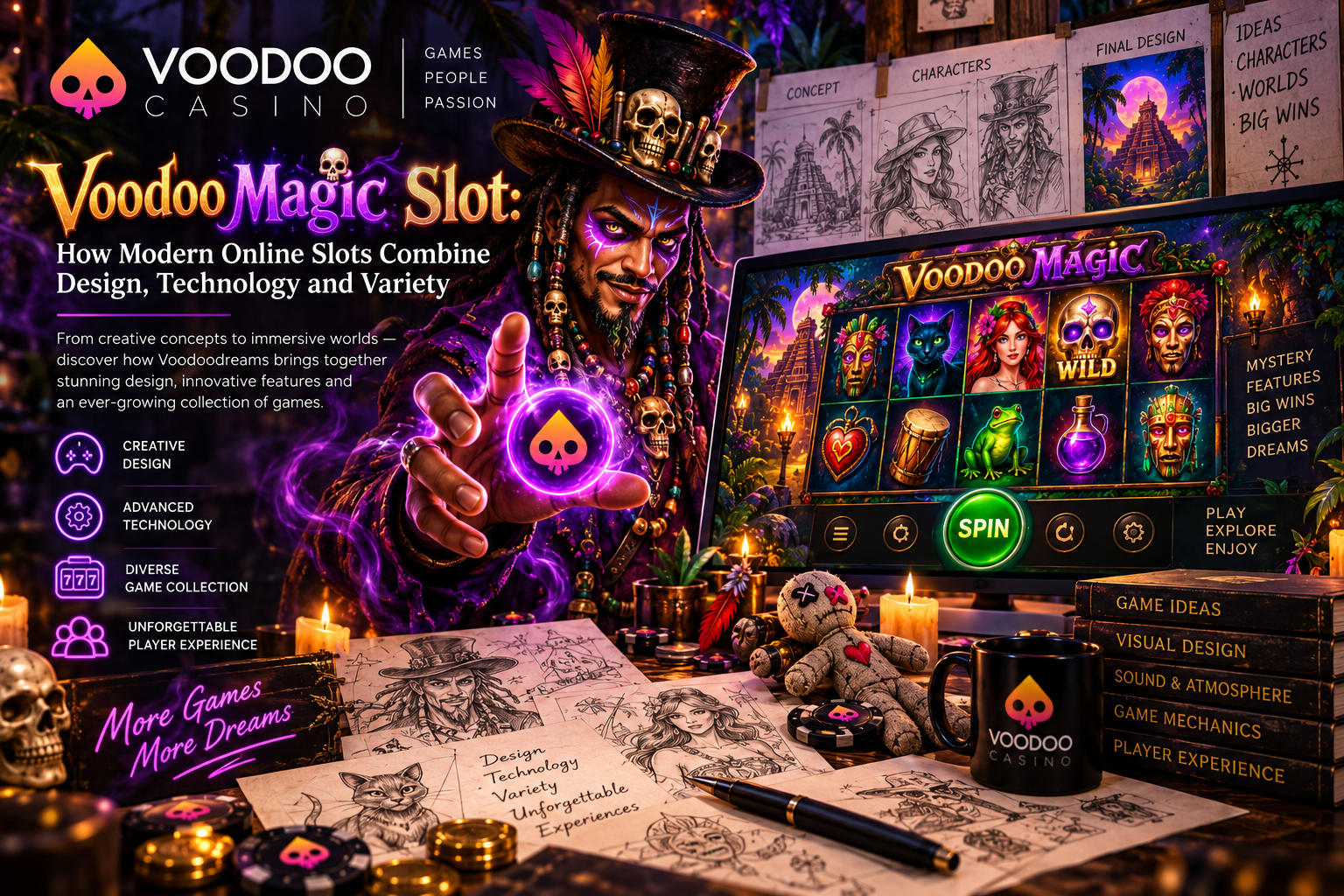
The modern slot is no longer simply a digital version of the mechanical machine found in traditional casinos. Software development, animation, mathematical modeling, responsive interfaces and increasingly sophisticated game mechanics have transformed the format into a broad category of interactive digital entertainment. The voodoo magic slot section provides a useful example of this development, bringing together thousands of titles from a diverse network of specialized game developers. The current German-language catalog contains 6,475 slot games.
Such a large selection changes the role of the casino website itself. The platform is no longer merely a place where individual games are launched. It also has to function as a discovery system, organizing a substantial amount of software into categories, provider collections and other navigation layers.
The Slot Has Become a Software Product
The visual simplicity of a slot interface can hide considerable technical complexity.
A modern game may combine animated graphics, sound, probability models, symbol-generation systems, bonus logic and multiple interactive states. Each component has to operate reliably while communicating with the broader casino environment.
The result is closer to a specialized software application than to a static digital recreation of a physical machine.
This transformation has also expanded the vocabulary of slot design. Traditional reels remain common, but developers now experiment with cascading systems, expanding symbols, multipliers, cluster mechanics, Hold and Win features, variable reel structures and other forms of interaction.
The basic idea remains recognizable, yet the underlying architecture can be considerably more sophisticated.
What a Catalog of 6,475 Slots Reveals
The current Voodoo Slots page lists 6,475 games, making it one of the largest individual sections of the platform.
However, the significance of that number lies less in quantity itself than in what it tells us about the modern casino business.
Thousands of titles cannot be developed and maintained by one internal team. Instead, large casino platforms rely on networks of independent providers, each contributing its own portfolio.
The current Voodoo catalog demonstrates this model particularly clearly. Its provider directory includes 1spin4win, 3 Oaks, Betsoft Gaming, BGaming, BigTimeGaming, Booming Games, Endorphina, Evolution, Hacksaw Gaming, NetGame, Novomatic, Pragmatic Play, Spinomenal, Yggdrasil and many other studios.
The casino therefore becomes an aggregation environment where many different development philosophies coexist.
Why Provider Diversity Matters
Every game provider approaches the slot format differently.
Some studios concentrate on traditional reel configurations, while others focus heavily on bonus mechanics or alternative mathematical structures. Some emphasize elaborate audiovisual presentation, whereas others prioritize simple interfaces and fast gameplay.
A large provider network gives users exposure to this diversity without requiring them to visit different websites.
The current Voodoo catalog includes 683 Spinomenal titles, 602 Pragmatic Play games, 339 Red Tiger Gaming titles and 227 Endorphina games, according to the provider figures displayed on the German Slots page.
These figures naturally change as content is added or removed, but they illustrate the scale of the underlying content ecosystem.
The provider has effectively become a second navigation layer. A user can search not only for a particular type of slot but also for games associated with a developer whose style is already familiar.
The Changing Mathematics of Slot Design
One of the most important developments in modern slots is the increasing variety of mathematical structures.
A conventional game might operate with a fixed number of reels and paylines. Contemporary titles can use ways-to-win systems, grids, clusters, expanding reels or changing numbers of symbols.
These structures influence how combinations are generated and how the visual state of the game changes.
However, mathematical complexity should not be confused with a greater likelihood of winning. A sophisticated mechanic changes the way a game operates; it does not remove the inherent uncertainty of gambling.
This distinction is particularly important when browsing a large catalog. Visual innovation and technical complexity can make games more interesting to explore, but neither provides a guarantee of a particular financial outcome.
The Rise of Feature-Based Gameplay
Another major development has been the growing importance of bonus features.
Modern slots frequently distinguish themselves through additional game states rather than through basic reel layouts alone. A feature may introduce respins, special symbols, multipliers, expanding positions or additional rounds.
The Voodoo catalog demonstrates how widespread this design philosophy has become. The current Slots page includes numerous titles with names and labels associated with Hold and Win, bonus and other feature-oriented formats.
From a development perspective, these features require additional software logic.
The game has to determine when a feature is activated, how symbols behave during the sequence, how values are stored and how the feature eventually returns the user to the base game.
What appears as a short animation on the screen can therefore represent a substantial amount of programmed logic.
Demo Mode as a Different Form of Interaction
A particularly useful feature of the current Voodoo Slots catalog is the availability of Demo buttons for many titles.
This changes the relationship between browsing and playing.
A visitor can interact with the software, examine its interface and understand its basic mechanics without immediately moving into real-money participation. For unfamiliar providers, this can be a practical way to discover how their games differ.
Demo access also makes the catalog more transparent from a user-experience perspective. A static thumbnail provides only a limited amount of information, while an interactive demonstration can reveal the structure of the actual software.
It is important, however, to maintain a clear distinction between demonstration and real-money gambling. Demo results do not predict future real-money outcomes, and experiencing a feature in a free environment does not create a financial expectation.
Why Mobile Design Is Now Fundamental
The modern slot is expected to function across a range of devices.
Smartphones have smaller screens, touch-based controls and different performance characteristics from desktop computers. As a result, developers have to consider responsive interfaces from the beginning of the development process.
Important buttons must remain accessible, text has to be readable and game elements need to adapt to different aspect ratios.
The surrounding casino website has a similar responsibility. A catalog containing thousands of games is particularly difficult to navigate on a small display, making clear categories and provider filters increasingly important.
The Voodoo Slots section addresses this challenge by combining a large game library with provider-based organization and distinct navigation categories.
From Static Reels to Dynamic Interfaces
The visual language of online slots has changed dramatically.
Earlier digital games often attempted to reproduce the appearance of physical machines. Contemporary titles are more willing to treat the screen as an interactive canvas.
Reels can expand, symbols can move across the grid, winning combinations can trigger additional animations and bonus features can transform the layout entirely.
This does not mean every modern game uses an elaborate system. Simpler designs remain popular because familiarity can itself be valuable.
The broader trend is toward giving developers more freedom to alter the relationship between symbols, space and interaction.
The Infrastructure Behind the Lobby
The casino lobby is another piece of software that requires significant engineering.
Voodoo currently lists more than 8,000 games across its overall German catalog, while the Slots section alone contains 6,475 titles.
Managing this volume requires an underlying content system capable of associating each title with a provider, category and status.
A single game may simultaneously be classified as a slot, a new release, a top title and part of a particular provider collection.
This explains why the visible interface can appear simple despite the complexity of the database behind it.
Every game tile represents a collection of metadata that determines where and how the title can be discovered.
The Importance of Continuous Content Updates
A modern casino catalog is constantly changing.
New titles enter the platform, existing games receive different levels of prominence and provider collections expand over time.
The current Voodoo Slots page already contains games marked “Neu” and “Top,” demonstrating that the catalog uses multiple discovery signals rather than treating all titles identically.
This creates a dynamic environment in which the content visible today may not be identical to what appears several weeks later.
For users, that means the casino lobby can function almost like a continuously updated digital media library.
For operators, it means that catalog management becomes an ongoing technical process rather than a one-time implementation.
Search and Categorization as Part of the Experience
When thousands of games are available, navigation becomes a central component of usability.
Voodoo’s German interface separates Slots from Live, Jackpot Games, Buy Feature, Recommended, Hot, All Games, Popular and True Labs.
The provider directory adds another level of filtering.
This approach recognizes that there is no single correct way to browse a large digital library.
Some users may want to discover the latest releases. Others may prefer established popular titles. Some may already know a particular provider, while others simply want to explore a broad category.
Good information architecture accommodates all of these behaviors without forcing visitors through the same sequence.
Regulation Should Not Be Confused With Game Popularity
A game’s position within a casino catalog is a matter of content organization. It should not be confused with legal authorization or a guarantee of quality.
This distinction is particularly important for German-language gambling platforms.
The German Joint Gambling Authority, GGL, maintains an official whitelist of gambling operators authorized under the German State Treaty on Gambling. The whitelist is updated regularly and should be consulted separately when assessing whether an operator is authorized to provide real-money gambling in Germany.
A provider’s presence in a casino catalog does not automatically establish that the operator itself is authorized in every jurisdiction.
Similarly, a “Top” or “Popular” label describes the platform’s content organization rather than guaranteeing any particular outcome.
The Difference Between Entertainment and Financial Expectations
The evolution of slot technology has made games more visually engaging and mechanically varied, but the fundamental nature of gambling remains unchanged.
A game can have elaborate graphics, multiple bonus stages and sophisticated mathematical architecture while still producing random outcomes.
This is why technological innovation should be viewed primarily as an evolution of entertainment design rather than as a method of improving financial certainty.
Demo access can help users understand the software without immediately introducing real-money stakes. If users choose to gamble for real money, the activity should be treated as entertainment involving financial risk.
Why the Modern Slot Is More Than a Reel
The current Voodoo Slots catalog provides a useful snapshot of how far the format has developed. With 6,475 titles and a large network of providers, the section contains a mixture of traditional concepts and increasingly sophisticated digital mechanics.
The modern slot is simultaneously a visual product, a mathematical system, a software application and a component of a larger casino platform.
Its development involves designers, programmers, mathematicians, sound specialists, quality-assurance teams and technical integration specialists.
The final interface may look simple, but the systems supporting it are anything but simple.
The Future of Slot Design
The next stage of online slot development will likely continue moving toward greater flexibility in game architecture.
Developers have already demonstrated that reels, grids, symbols and bonus systems can be rearranged in countless ways. Future innovation is likely to focus on how these components interact, how quickly games can respond across devices and how digital interfaces can remain understandable despite increasing technical complexity.
At the platform level, the challenge will be different. As catalogs continue to grow, operators will need better ways of organizing and presenting that content without overwhelming users.
The current Voodoo Slots environment illustrates both sides of this evolution. Its thousands of titles demonstrate the scale of modern casino content, while its provider categories, discovery labels and demo functionality show how a large library can be transformed into a more navigable digital experience.
The real “magic” of the modern slot is therefore not simply found in its graphics or themes. It lies in the combination of mathematics, software engineering, visual design, mobile technology and content architecture that allows a traditional casino format to function as a sophisticated form of digital entertainment.